



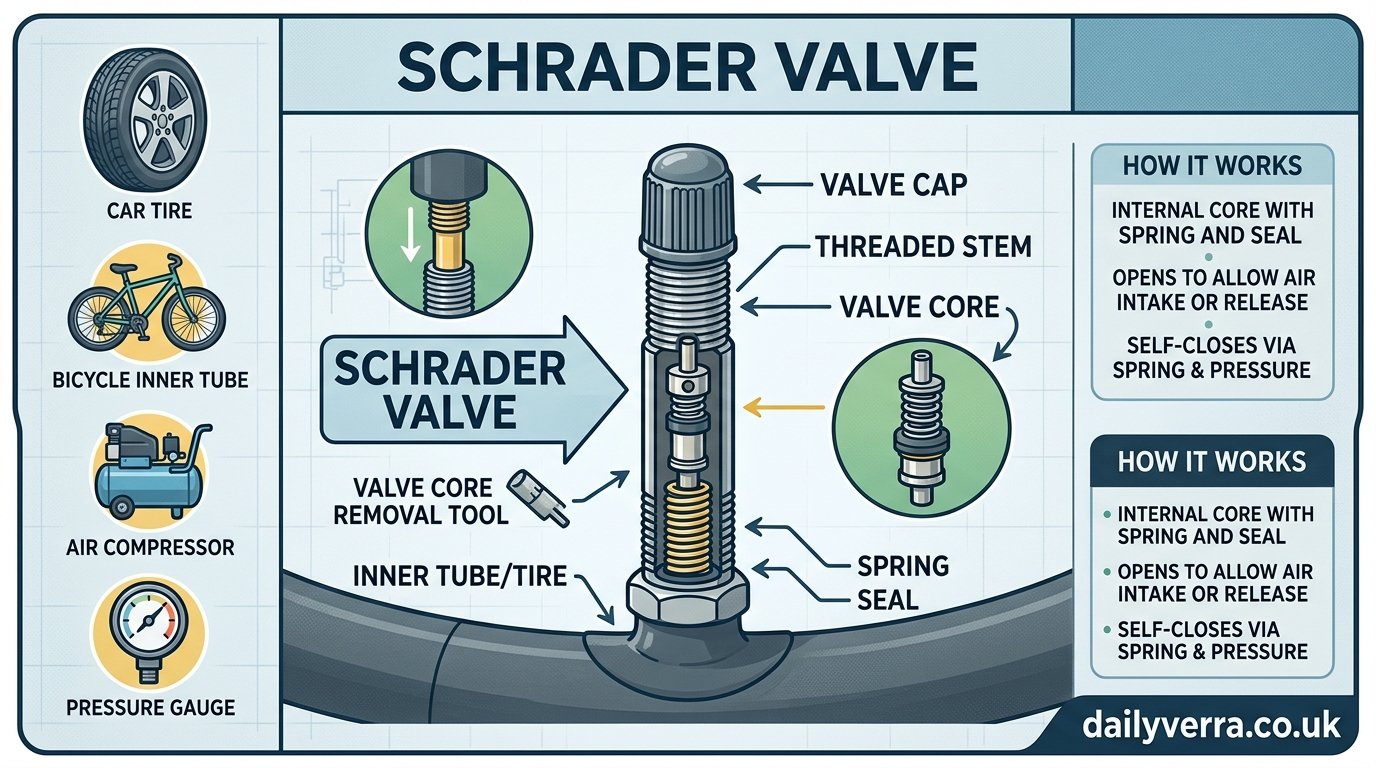
A Schrader valve is one of the most common and dependable valve types used for controlling the flow of air and gases in pressurized systems. Although it is a small component, it performs a vital role in maintaining the correct pressure inside vehicle tires, bicycle tires, air conditioning systems, refrigeration equipment, and various industrial machines. Most people encounter a Schrader valve every time they inflate a car tire, yet few realize how much engineering goes into this simple device. Its reliable sealing mechanism, durable construction, and universal compatibility have made it the preferred valve design across countless industries.
The popularity of the Schrader valve comes from its ability to provide an airtight seal while allowing quick inflation and pressure checks. Whether connected to a portable air compressor, a tire pressure gauge, or professional servicing equipment, the valve offers consistent performance with minimal maintenance. Because proper air pressure directly affects safety, efficiency, equipment lifespan, and operating costs, understanding how a Schrader valve works is valuable for vehicle owners, technicians, cyclists, and anyone responsible for maintaining pressurized systems.
What Is a Schrader Valve?
A Schrader valve is a spring-loaded valve that controls the movement of air or gas into and out of a sealed chamber. It consists of a threaded metal valve stem containing a removable valve core. Inside the core is a small spring and sealing mechanism that automatically closes when pressure is removed. When an air chuck or inflator presses the center pin, the valve opens to allow compressed air to flow into the system. Once the inflator is removed, the spring instantly closes the valve, preventing unwanted air leakage.
The Schrader valve was developed in the late nineteenth century by August Schrader, whose company specialized in pneumatic equipment. Over time, the design became the global standard for automotive tires because of its simplicity, durability, and reliability. Today, Schrader valves are manufactured according to standardized dimensions, making them compatible with nearly every automotive tire inflator, pressure gauge, and portable air compressor available on the market. Their widespread adoption has simplified tire maintenance and servicing for millions of users around the world.
In addition to tires, Schrader valves are used in heating, ventilation, air conditioning, refrigeration systems, industrial pneumatic equipment, hydraulic accumulators, compressed gas cylinders, and specialized medical devices. Their versatility demonstrates how a seemingly small mechanical component can play an essential role in many modern technologies.
How a Schrader Valve Works
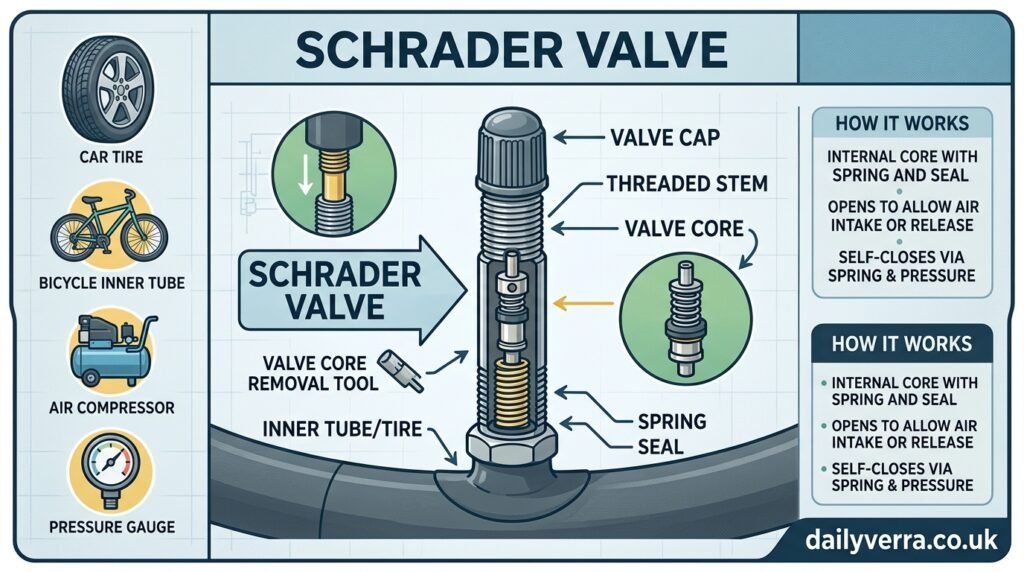
The operating principle of a Schrader valve is both simple and highly effective. At the center of the valve stem is a movable pin attached to a spring-loaded valve core. Under normal conditions, the spring keeps the internal seal tightly closed, preventing air from escaping. When an air pump, pressure gauge, or service connector presses the center pin inward, the seal temporarily opens and allows air or gas to flow through the valve.
During tire inflation, compressed air enters through the valve opening and increases the internal tire pressure until the desired pressure is reached. As soon as the inflator is disconnected, the spring immediately forces the valve back into its sealed position. This automatic closing action minimizes pressure loss and ensures reliable air retention even after repeated use.
The removable valve core is one of the most practical features of the Schrader valve. If the internal seal becomes worn, damaged, or contaminated with dirt, technicians can replace only the valve core instead of replacing the entire valve stem. This design significantly reduces maintenance costs while extending the lifespan of the complete valve assembly. The addition of a protective valve cap further shields the internal mechanism from dust, moisture, road salt, and debris that could interfere with proper sealing.
