



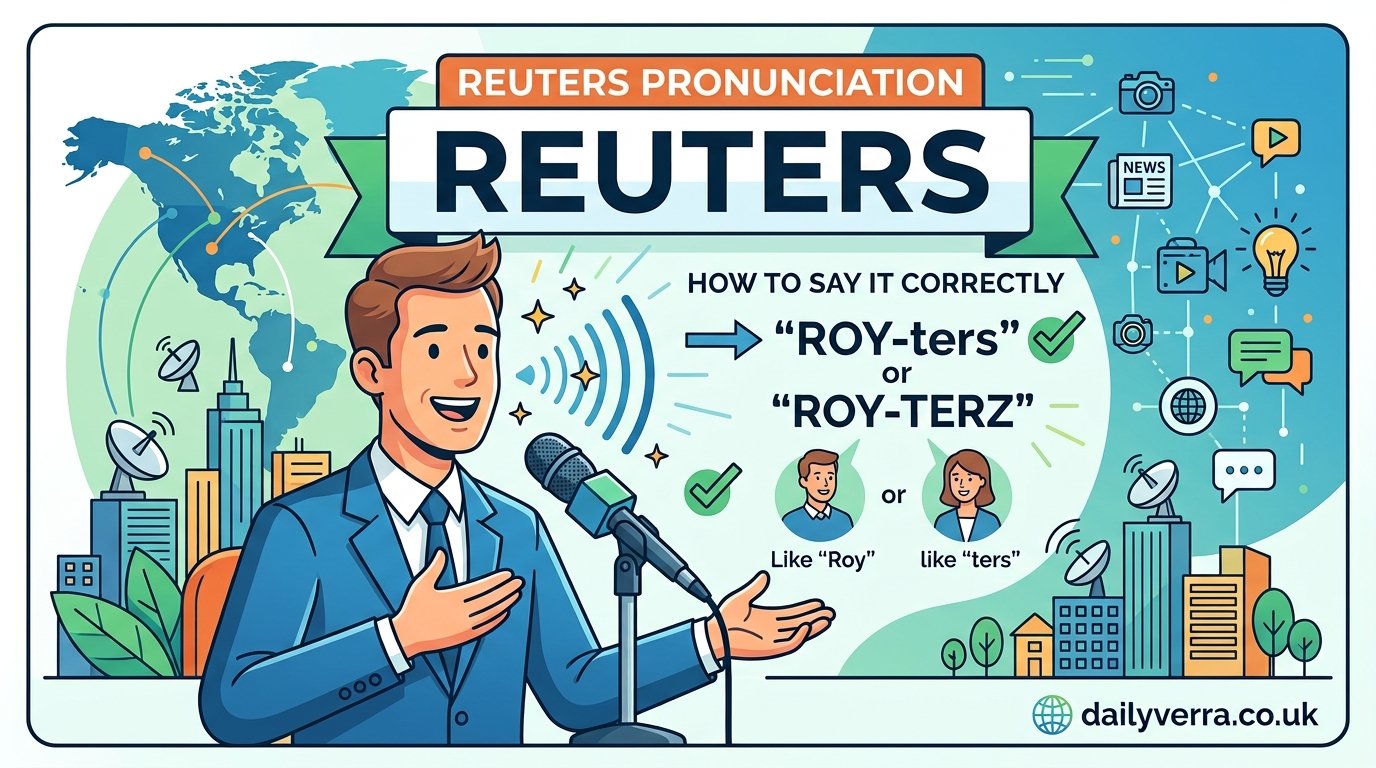
If you have ever watched international news, read business reports, or followed major world events, you have probably seen the name Reuters. It is one of the most recognizable names in global journalism, but its pronunciation can be surprisingly confusing for English learners and even native speakers. Many people pronounce it as “roo-ters,” “ray-ters,” or “ree-ters” because the spelling does not immediately reveal how the word should sound.
Understanding the correct Reuters pronunciation is useful if you regularly follow news, participate in conversations about journalism, or want to speak English more naturally. The name comes from the surname of Paul Julius Reuter, the founder of the news agency, which helps explain why its pronunciation does not follow the pattern some readers might expect from its spelling.
Reuters
ROY-terzPractice in VoiceAdd to flashcards
Give feedback
What Is the Correct Reuters Pronunciation?
The commonly used English pronunciation of Reuters begins with a sound similar to “roy.” The first part rhymes closely with words such as “boy” and “toy.” The second part is a short “ter” sound, followed by a light “z” sound at the end.
For many English speakers, thinking of the word as two simple parts can make it easier to remember. The first part carries the main emphasis, while the ending is spoken more quickly. The result is a smooth two-syllable pronunciation rather than a pronunciation based directly on each letter.
The pronunciation may sound slightly different depending on a speaker’s accent. British and American English can differ in vowel quality and rhythm, but the basic pronunciation remains recognizable. You do not need to imitate a particular accent to say the name correctly.
A useful way to practice is to say the first syllable clearly and then move quickly into the second. Avoid placing equal emphasis on both parts. Like many well-known names, Reuters is easier to pronounce when it is spoken naturally rather than slowly spelling out each letter.

Why Is Reuters Pronunciation So Confusing?
The main reason the word causes confusion is its spelling. English has many words whose pronunciation cannot be predicted perfectly from their written form, and Reuters is a good example.
Someone seeing the word for the first time may naturally try to pronounce the opening letters as “ree,” “ray,” or “roo.” This happens because English readers often use familiar spelling patterns to guess unfamiliar words. In this case, those patterns can lead to a pronunciation that sounds different from the established name.
Another reason is that Reuters is a surname rather than an ordinary English vocabulary word. Surnames often preserve pronunciations that developed from particular languages, regions, or family histories. As a result, the spelling may not behave like a modern English word.
The name is connected to Paul Julius Reuter, who established the news agency in the nineteenth century. Because the company became internationally famous, the family name became familiar to audiences far beyond its original historical context.
The word is also commonly encountered in written form. People may read “Reuters” thousands of times before ever hearing someone say it aloud. This is especially common for students, online readers, and people who primarily consume news through websites or written articles.
How to Remember the Correct Sound
One of the easiest ways to remember the Reuters pronunciation is to connect its opening sound with familiar English words. The beginning is close to the sound found in “roy,” while the ending is short and unstressed.
Rather than focusing on every letter, focus on the sound of the complete name. This approach is often more effective because English pronunciation does not always correspond directly to spelling.
You can also practice the word in a sentence. For example, imagine saying, “I read the story on Reuters this morning.” Repeating the complete sentence helps you develop a natural rhythm instead of treating the name as an isolated collection of letters.
Another helpful technique is listening. If you frequently watch international news broadcasts, pay attention when professional journalists mention Reuters. Hearing the word repeatedly in real conversations can help reinforce its pronunciation and rhythm.
It is also useful to practice without exaggerating the sounds. Learners sometimes pronounce unfamiliar words too slowly, making every syllable equally strong. In everyday speech, Reuters is generally said quickly and naturally.
Common Mispronunciations of Reuters
Because the spelling is unusual, several incorrect pronunciations appear frequently. Some people begin the word with a long “ree” sound, while others pronounce the first syllable more like “ray.” Another common mistake is to make the second syllable too strong.
These mistakes are understandable. They usually happen because the speaker is trying to decode the spelling according to familiar English pronunciation rules. Making a mistake does not mean the speaker has poor English; Reuters is simply one of those names that has to be learned as a complete pronunciation.
A common improvement is to stop thinking of the word as “Re-u-ters” and instead learn its established sound as a single name. Once you have heard it several times, it becomes much easier to recognize and reproduce.
It is also worth remembering that accents naturally affect pronunciation. A British speaker, an American speaker, and a speaker from another English-speaking region may produce slightly different vowel sounds. These differences should not be confused with completely different pronunciations.
Why Reuters Is Such a Familiar Name
Reuters is widely recognized because of its long history in international journalism. The organization began in the nineteenth century and developed a major role in distributing news across borders.
Its reporting has covered politics, economics, financial markets, technology, business, sports, and major international events. As a result, the name appears regularly in newspapers, websites, television reports, research articles, and social media discussions.
For many readers, “Reuters” is not just a company name but also a familiar source attribution. News stories may mention that information was reported by Reuters or use Reuters material as part of broader coverage.
This widespread presence explains why learning the correct pronunciation can be useful. Someone who frequently follows current events may encounter the name in conversation as often as in writing.
Reuters Pronunciation in Everyday English
In everyday conversation, you may hear phrases such as “According to Reuters” or “Reuters reported today.” The name usually fits naturally into the sentence without being emphasized heavily.
If you are speaking in a professional setting, clear pronunciation is more important than trying to copy a particular accent. A natural, confident pronunciation is enough.
When introducing the name to someone who has never heard it before, saying it clearly once is usually sufficient. There is no need to over-explain the spelling unless the listener asks.
The same principle applies when giving presentations or discussing news stories in class. Practice the name beforehand if you expect to use it repeatedly. After a few repetitions, it should become much easier to say automatically.
The History Behind the Name
The story behind Reuters pronunciation becomes more interesting when you consider its founder. Paul Julius Reuter was a German-born entrepreneur who became known for building an international news service.
His name became attached to the organization that eventually grew into one of the world’s best-known news providers. Over time, the company name became a familiar part of international journalism.
Historical surnames can retain pronunciation characteristics that may not be obvious to modern readers. This is one reason learning the pronunciation of a proper name is often different from learning the pronunciation of a regular English word.
Knowing this background can also make the word easier to remember. Instead of seeing Reuters as a strange combination of letters, you can associate it with a person’s surname and the history of an international news organization.
Tips for English Learners
English learners can make pronunciation practice easier by concentrating on listening, rhythm, and repetition rather than spelling alone. Start by hearing the word several times and then repeat it naturally.
Try saying it inside familiar sentences rather than repeating the word in isolation. For example, you might practice sentences about reading a Reuters report, watching a Reuters story, or discussing information published by Reuters.
It can also help to record yourself speaking and compare your version with professional speakers. Listen for the stress pattern and the way the second part becomes lighter and quicker.
Most importantly, do not become overly concerned about having a perfect accent. The goal is clear communication. Small differences caused by regional accents are normal and generally do not prevent people from understanding the word.
Final Thoughts on Reuters Pronunciation
The correct Reuters pronunciation may seem difficult at first because the spelling does not make the sound immediately obvious. Once you learn the basic pronunciation and practice it in natural sentences, however, the word becomes much easier to say.
The key is to focus on the sound rather than trying to pronounce every letter exactly as it appears. Remember the strong opening sound, keep the ending relatively light, and practice the name in ordinary conversation.
Whether you follow international news, study English, work with business information, or simply want to improve your vocabulary, knowing how to pronounce Reuters confidently is a small but useful language skill. With a little listening and repetition, the name can quickly become one of those words that feels completely natural to say.
