



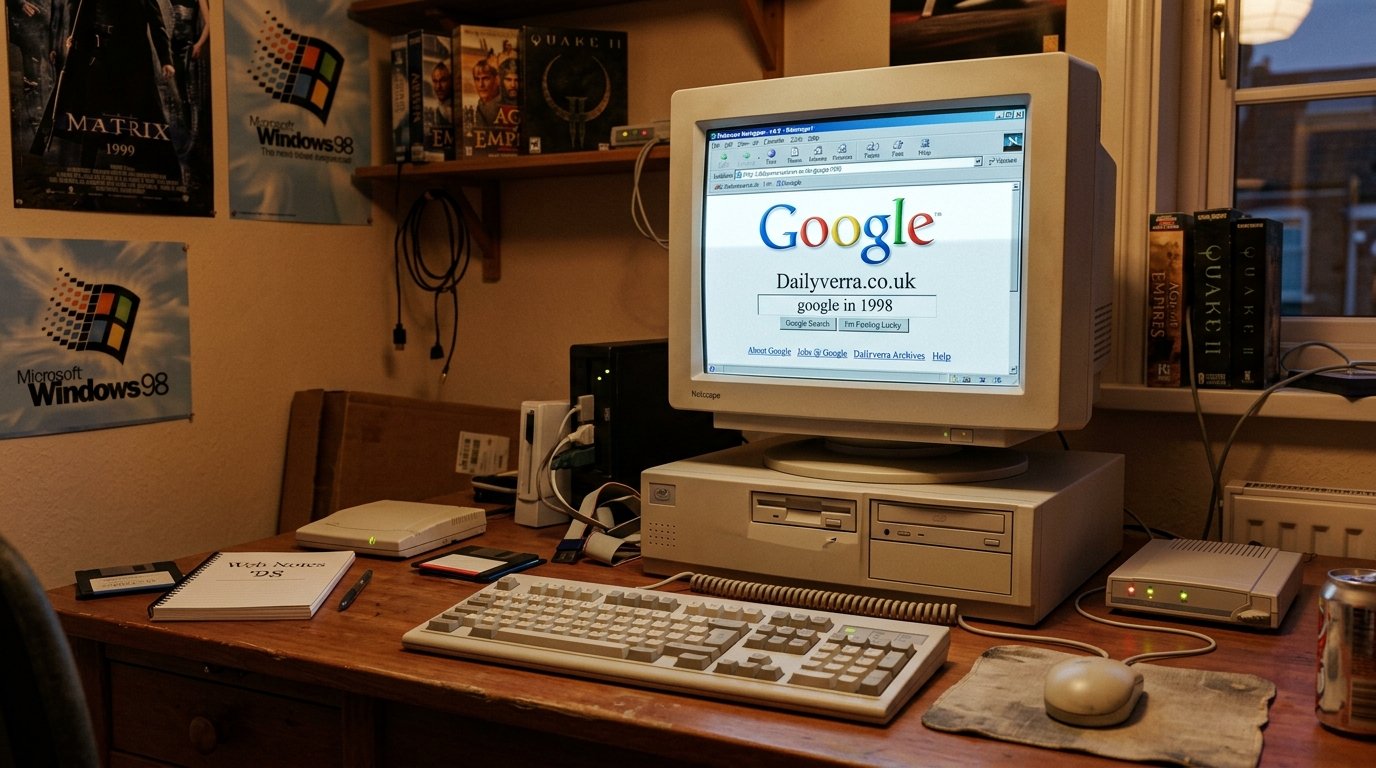
In 1998, the internet looked very different from the connected digital world we know today. Search engines already existed, websites were becoming more common, and people were beginning to discover the possibilities of the World Wide Web. Yet finding useful information online was often frustrating. Search results could be difficult to organize, and users frequently had to sort through pages that were only loosely related to what they were looking for.
This was the environment in which Google began its journey. Google in 1998 was not the enormous technology company it would eventually become. It was a young search project created by two Stanford University graduate students, Larry Page and Sergey Brin. Their idea was relatively simple but powerful: make search results more useful by understanding the relationships between websites and determining which pages were more important.
The year 1998 became an important milestone because it marked the official beginning of Google as a company. From a small project associated with Stanford to one of the most recognizable names in technology, Google’s early history shows how a focused idea can develop into something much larger.
What Was Google Like in 1998?
The story of Google actually began before 1998. Larry Page and Sergey Brin met at Stanford University in the mid-1990s and eventually began working together on a research project involving the structure of the World Wide Web. Page became particularly interested in the idea of treating links between websites as a way to understand the importance of individual pages.
At the time, many search engines primarily focused on matching words found on webpages with words entered by users. Page and Brin approached the problem differently. They developed a system that considered links between webpages as signals of importance. Their research project became known as BackRub.
BackRub operated on Stanford’s servers and explored the relationships between webpages. The project eventually evolved into what became Google. The name “Google” was inspired by the mathematical term “googol,” which represents the number 1 followed by 100 zeros. The name reflected the founders’ ambition to organize an enormous amount of information.
By 1998, Google was becoming more than a university research experiment. The founders were preparing to turn their technology into a real business. On September 4, 1998, Google was officially incorporated as a company.
The early Google homepage was remarkably simple compared with the feature-filled websites associated with the company today. There were no extensive menus, advertisements covering the screen, news feeds, shopping sections, video recommendations, or personalized services. Instead, visitors encountered a clean search interface focused on one central task: finding information.
That simplicity became one of Google’s defining characteristics.
Why Google’s Search Technology Was Different
One of the most important ideas behind Google in 1998 was PageRank. Although the technology was more complex than a simple popularity counter, the basic concept was easy to understand. A webpage could be considered important when other important webpages linked to it.
This approach gave Google a way to evaluate the broader structure of the web rather than simply looking for repeated words. A page with useful connections could potentially rank more highly than another page that simply contained the same words many times.
Imagine the early internet as a growing library without a complete catalog. A traditional search system might look for books containing particular words. Google’s approach tried to understand which books were being recommended or referenced by other valuable books. That additional layer of information could make the results more useful.
This was especially valuable because the number of webpages was increasing rapidly. As more people, universities, organizations, and businesses created websites, finding reliable information became increasingly challenging.
Google’s founders believed that the relationships between webpages could provide important clues about quality and relevance. Their research paper on the structure of the web helped establish the intellectual foundation for their search technology.
The company was still tiny in 1998, but its underlying idea had significant potential. Instead of trying to become everything for everyone immediately, Google concentrated on making search work better.
That focus was one of the reasons the project attracted attention.
The Google Homepage and Early Internet Experience
Google in 1998 had an appearance that feels almost unbelievably simple when compared with the modern internet. The homepage centered on the Google logo and a search box. Users could enter a query and receive results without navigating through a complicated collection of features.
This simplicity was particularly noticeable because many websites of the period were becoming visually busy. Internet connections were slower, webpages often loaded gradually, and web design was still developing. A lightweight search page could therefore feel fast and convenient.
The minimalist design also communicated a clear purpose. Google was there to help users search.
In its early days, Google did not have the enormous collection of services that people now associate with the brand. There was no Google Maps, Gmail, Google Drive, YouTube, Android, or Google Photos. The company’s identity was closely tied to web search.
The difference between Google in 1998 and Google today is therefore enormous. Modern Google operates across many areas of technology, advertising, cloud computing, artificial intelligence, mobile software, hardware, and online services. In 1998, however, the company was essentially a small startup built around an innovative search engine.
The early homepage also became memorable because it resisted unnecessary complexity. Users could arrive, type a query, and search. That straightforward experience helped establish a recognizable identity.
From Stanford Project to Real Company
Turning a university research project into a business was not an automatic decision. Page and Brin initially explored the possibility of licensing their search technology to existing companies. Eventually, they decided to build their own company.
Google’s early development received support from people who recognized the potential of the technology. One of the most important early supporters was Sun Microsystems co-founder Andy Bechtolsheim, who wrote a substantial check to Google before the company had fully established its corporate structure.
This early financial support helped Page and Brin move forward with their plans.
The company was initially based in a garage in Menlo Park, California, associated with Susan Wojcicki, who later became a major executive at Google and YouTube. The garage has since become part of the familiar mythology surrounding Google’s beginnings.
It is worth remembering how small the company was at this stage. Google did not begin with the massive offices, worldwide data centers, thousands of employees, and enormous financial resources that would characterize it later. It began with a relatively small team and an ambitious technical idea.
That contrast makes the history of Google in 1998 particularly interesting. The company that would eventually influence how billions of people access information was still in its earliest stage.
What Made 1998 Such an Important Year?
The importance of 1998 goes beyond the official incorporation date. It represents the moment when Google’s founders moved from academic research toward building a commercial organization.
The late 1990s were an exciting period for internet technology. New websites and online businesses were appearing quickly, and investors were increasingly interested in the possibilities of the web. At the same time, users were still learning how to navigate a rapidly expanding digital environment.
Search was becoming increasingly important because the web was becoming increasingly difficult to explore manually.
Google entered this environment with a clear advantage: its founders were focused on improving the quality of search results. Rather than simply making a website where people could search, they were attempting to solve a difficult information problem.
That distinction mattered.
A search engine becomes valuable when it helps people find useful information efficiently. Google’s early technology was designed around that principle. The company did not need to offer every possible internet service in 1998. It needed to prove that its search results could be better.
Over time, that focus helped Google build a reputation among internet users.
The Beginning of a Much Bigger Future
Looking back, it is easy to view Google in 1998 through the lens of what the company eventually became. But the early Google was far removed from today’s technology giant.
There was no guarantee that it would dominate search. Other search engines were already established, and the internet industry was changing quickly. The company’s success depended on continuing to improve its technology while developing a sustainable business model.
Google’s eventual growth was driven by several factors, including the usefulness of its search technology, the expansion of the internet, improvements in computing infrastructure, and the company’s ability to develop new products and services.
Yet the central idea remained surprisingly consistent: helping people find information.
That original purpose became the foundation for a much broader technological ecosystem. Search eventually became connected with advertising, maps, email, video, mobile devices, cloud services, productivity tools, and countless other digital experiences.
The company that began in the late 1990s would eventually become one of the most influential technology organizations in the world.
Google in 1998 vs. Google Today
The difference between Google in 1998 and Google today is perhaps best understood by considering scale.
In 1998, Google was a young company with a simple interface and a highly focused product. Its primary challenge was improving web search and convincing users that its results were useful.
Today, Google is part of Alphabet and operates a vast range of products and technologies. Search remains central to its identity, but users also encounter Google through smartphones, web browsers, maps, video platforms, email, online storage, productivity applications, advertising systems, and artificial intelligence tools.
The visual difference is equally striking. The clean homepage has remained recognizable, but the technology behind it has become vastly more sophisticated.
What has not changed is the basic expectation that users can enter a question or phrase and quickly receive useful information.
That simple interaction is one of the most enduring parts of Google’s history.
Conclusion: Why Google in 1998 Still Matters
Google in 1998 represents the beginning of one of the most influential stories in internet history. What started as a research project at Stanford University developed into a company built around a straightforward but ambitious goal: improving the way people find information online.
The early Google was small, simple, and focused. Its homepage did not contain the enormous collection of services we associate with Google today. Instead, it offered a search box and an innovative system for organizing web information.
The significance of 1998 lies in that combination of simplicity and ambition. Larry Page and Sergey Brin recognized that the rapidly growing web needed better ways to organize information, and their work offered a new approach to the problem.
More than two decades later, the internet has changed dramatically, but the importance of search remains. Google’s journey from a Stanford research project to a global technology company demonstrates how a powerful idea can grow when technology, timing, persistence, and innovation come together.
For anyone interested in internet history, Google in 1998 is more than an old version of a familiar website. It is a snapshot of the moment when a small search project began laying the foundation for a digital revolution that would reshape how people find, share, and interact with information.
