



Introduction
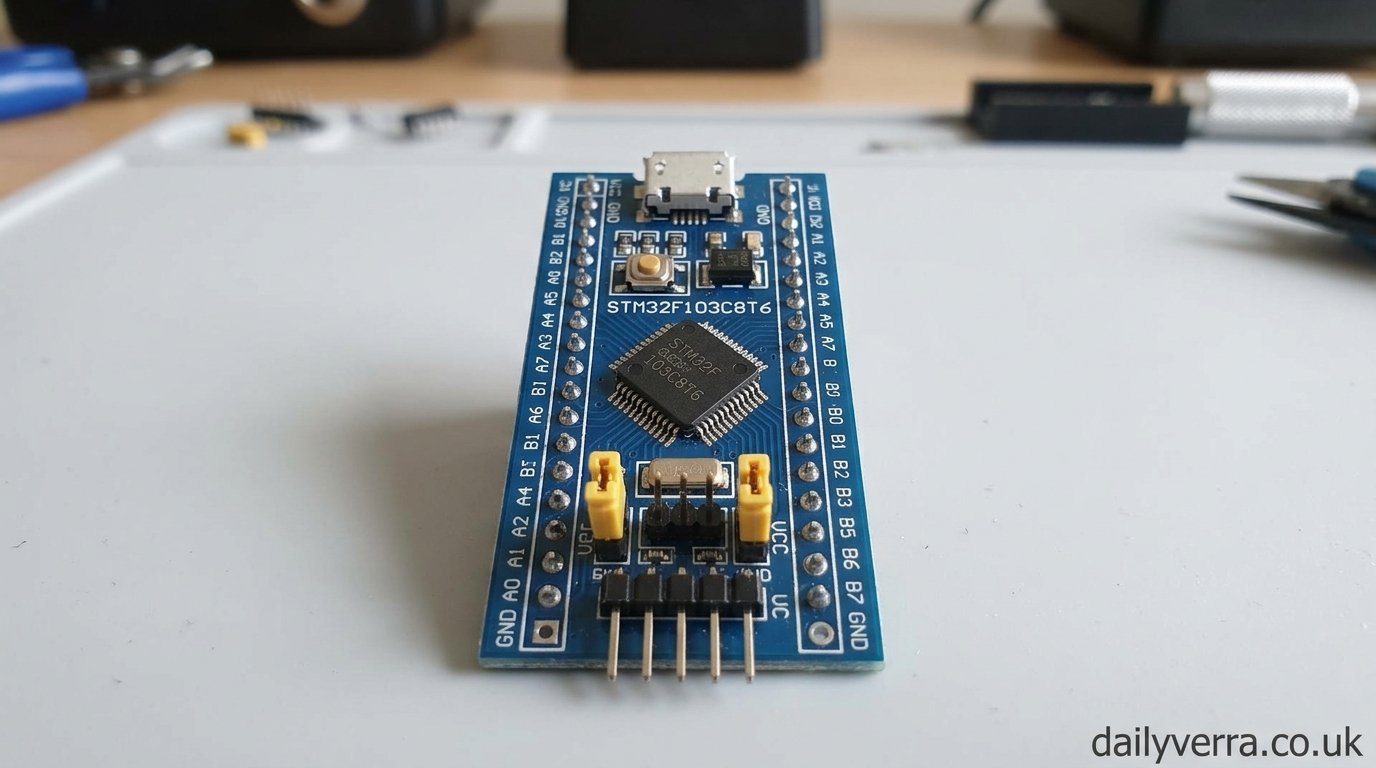
The STM32F103C8T6 is one of the most recognized and widely used microcontrollers in the embedded systems industry. Developed by STMicroelectronics, this powerful 32-bit microcontroller belongs to the STM32F1 family and is based on the ARM Cortex-M3 core. Over the years, it has become a favorite among electronics engineers, embedded developers, students, makers, and hobbyists because it delivers excellent performance at a low cost while providing a rich set of integrated peripherals.
The growing popularity of embedded systems, Internet of Things devices, industrial automation, robotics, smart sensors, and consumer electronics has increased demand for efficient microcontrollers that can balance performance, power consumption, and affordability. The STM32F103C8T6 successfully meets these requirements and remains one of the most recommended devices for learning ARM-based programming and building commercial embedded products.
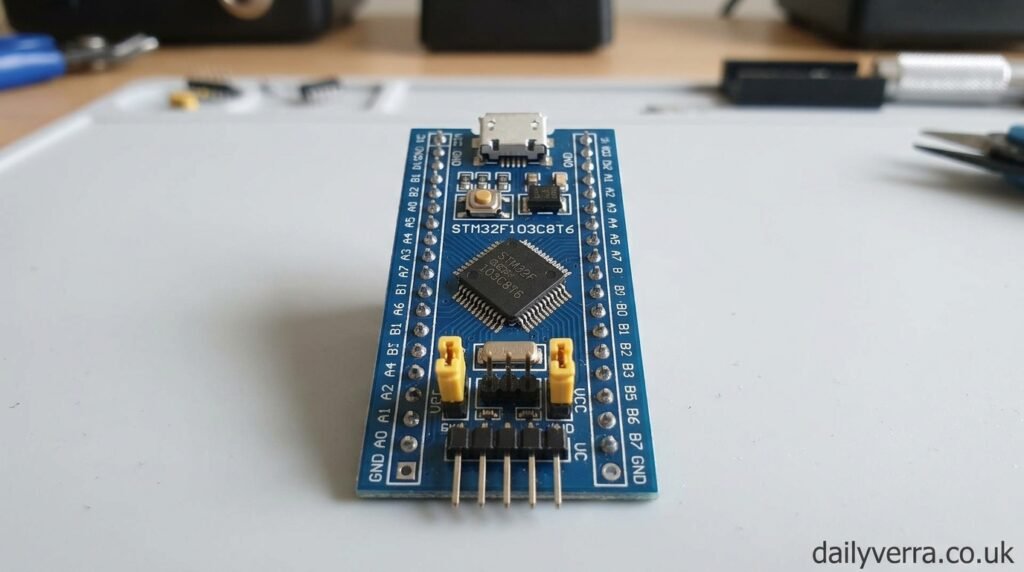
Many developers first encounter this microcontroller through the famous Blue Pill development board, which provides an inexpensive platform for experimentation and learning. Despite the availability of newer STM32 families, the STM32F103C8T6 continues to be widely adopted because of its proven reliability, extensive documentation, active community support, and compatibility with modern development tools.
Understanding the STM32F103C8T6 Architecture
The STM32F103C8T6 is built around the ARM Cortex-M3 processor core, a 32-bit RISC architecture designed specifically for embedded applications. The Cortex-M3 architecture introduced significant improvements over traditional 8-bit and 16-bit microcontrollers by offering greater processing power, faster execution, and improved memory management while maintaining low power consumption.
Operating at frequencies up to 72 MHz, the microcontroller is capable of handling complex real-time applications with remarkable efficiency. The processor includes advanced interrupt management through the Nested Vectored Interrupt Controller, commonly known as NVIC. This feature allows the microcontroller to respond quickly to external events, making it ideal for time-sensitive applications such as motor control, sensor monitoring, communication systems, and industrial automation.
The architecture also incorporates hardware support for debugging and system exception handling. Developers can analyze program execution, monitor variables, and troubleshoot firmware with precision. This significantly reduces development time and improves software reliability. The combination of ARM Cortex-M3 technology and STM32 engineering has helped establish the STM32F103C8T6 as one of the most successful microcontrollers in the embedded industry.
Technical Specifications and Core Features
One of the primary reasons for the popularity of the STM32F103C8T6 is its impressive set of technical specifications. The microcontroller typically provides 64 KB of Flash memory for program storage and 20 KB of SRAM for runtime operations. These memory resources are sufficient for a wide range of embedded applications, from simple sensor interfaces to sophisticated control systems.
The device operates within a supply voltage range of approximately 2.0 V to 3.6 V, making it suitable for battery-powered and portable electronics. It is packaged in a compact LQFP-48 package and offers up to 37 configurable GPIO pins. These pins can perform multiple functions including digital input, digital output, analog input, external interrupts, and communication interfaces.
Integrated peripherals further enhance the capabilities of the STM32F103C8T6. The microcontroller includes advanced timers, watchdog timers, communication interfaces, analog-to-digital converters, pulse-width modulation modules, and clock management systems. These features eliminate the need for many external components and simplify hardware design while reducing overall system cost.
Memory Organization and Processing Performance
Memory architecture plays a critical role in the overall performance of any microcontroller. The STM32F103C8T6 uses embedded Flash memory to store application firmware and SRAM to hold temporary data during execution. The separation of program and data memory enables efficient operation and supports multitasking-like functionality within embedded applications.
The ARM Cortex-M3 core can execute instructions significantly faster than many traditional microcontrollers. This allows developers to implement advanced algorithms, mathematical computations, digital filtering, and communication protocols without compromising responsiveness. Applications involving real-time monitoring and control particularly benefit from the enhanced computational capabilities.
Clock management features provide flexibility in balancing performance and power consumption. Developers can configure various clock sources and frequencies depending on application requirements. High-speed operation can be used when maximum performance is required, while lower clock settings help conserve energy in battery-operated devices. This adaptability contributes to the microcontroller’s widespread use across diverse industries.
GPIO Capabilities and Peripheral Interfaces
The General Purpose Input Output subsystem is one of the most versatile aspects of the STM32F103C8T6. Each GPIO pin can be configured independently to perform different tasks based on application requirements. This flexibility enables designers to create complex systems without requiring specialized external hardware.
Communication capabilities are particularly impressive. The microcontroller supports Universal Asynchronous Receiver Transmitter interfaces for serial communication, Serial Peripheral Interface for high-speed peripheral connectivity, and Inter-Integrated Circuit communication for sensor and device networking. These interfaces allow seamless communication with displays, sensors, wireless modules, memory devices, and industrial equipment.
Additional functionality includes USB support and various timer modules capable of generating precise timing signals. The extensive peripheral ecosystem enables developers to integrate multiple subsystems within a single design while maintaining efficient communication and control. This level of integration is one of the key factors behind the STM32F103C8T6’s continued popularity.
Analog Features and Signal Processing Capabilities
Modern embedded systems often require interaction with analog signals generated by sensors and measurement devices. The STM32F103C8T6 addresses this requirement through its integrated 12-bit Analog-to-Digital Converter. This ADC allows the microcontroller to measure analog voltages with high accuracy and convert them into digital values for processing.
The ADC can be used in applications involving temperature measurement, pressure sensing, light detection, battery monitoring, current measurement, and environmental data collection. The ability to directly process sensor outputs simplifies system architecture and reduces component count. Engineers can develop sophisticated monitoring systems without requiring external conversion hardware.
Signal processing capabilities are further enhanced by the performance of the ARM Cortex-M3 core. Digital filtering, averaging, calibration algorithms, and sensor fusion techniques can be implemented efficiently. These capabilities make the STM32F103C8T6 suitable for industrial instrumentation, smart sensors, medical devices, and data acquisition systems.
Development Environment and Programming Tools
The STM32 ecosystem provides a comprehensive set of software development tools that simplify firmware creation and debugging. Developers commonly use STM32CubeIDE, which integrates project management, code generation, compiling, debugging, and device configuration within a single environment. This unified workflow improves productivity and reduces development complexity.
Programming the STM32F103C8T6 can be accomplished using several methods. ST-Link programmers are widely used for debugging and firmware uploading, while serial bootloader functionality allows firmware updates through UART communication. These programming options provide flexibility during both development and production stages.
A major advantage of the STM32 platform is the availability of extensive software libraries and hardware abstraction layers. These resources allow developers to focus on application logic rather than low-level hardware configuration. The result is faster development cycles, improved code maintainability, and greater reliability in deployed systems.
Blue Pill Development Board and Community Adoption
The Blue Pill development board has become almost synonymous with the STM32F103C8T6. This compact and affordable board exposes most of the microcontroller’s features while providing essential supporting components such as crystal oscillators, voltage regulators, and programming connections. Its low cost has made advanced ARM microcontroller development accessible to a broad audience.
Educational institutions frequently use the Blue Pill board to teach embedded systems programming and microcontroller fundamentals. Students gain practical experience with professional-grade ARM technology while learning concepts such as GPIO programming, interrupt handling, communication protocols, and real-time system design. The board’s affordability allows widespread adoption in classrooms and laboratories.
Community support is another major factor behind its success. Thousands of tutorials, forums, open-source projects, libraries, and application examples are available online. Developers can quickly find solutions to technical challenges, accelerate learning, and leverage existing resources when creating new projects. This extensive ecosystem continues to attract new users and reinforce the microcontroller’s popularity.
Applications Across Industries
The STM32F103C8T6 is used in a wide range of industries because of its versatility and reliable performance. In industrial automation, it serves as the control unit for machinery, sensor networks, motor drives, and monitoring systems. Its ability to process data in real time and communicate with external equipment makes it ideal for factory environments.
Robotics applications frequently utilize the STM32F103C8T6 for motion control, sensor integration, navigation systems, and actuator management. The combination of fast processing and precise timing allows robotic systems to execute complex tasks accurately and efficiently. Educational robotics kits and commercial robotic platforms often incorporate this microcontroller.
Consumer electronics also benefit from the device’s capabilities. Smart home products, wireless monitoring devices, wearable technology, portable instruments, and digital control systems commonly use the STM32F103C8T6 as their primary processing unit. Its low power consumption and integrated functionality help manufacturers reduce product size and production costs while maintaining high performance.
Power Management and Energy Efficiency
Energy efficiency is increasingly important in modern electronics, particularly in battery-powered and portable devices. The STM32F103C8T6 includes several power-saving modes designed to minimize energy consumption without sacrificing functionality. These modes allow the microcontroller to enter low-power states when active processing is not required.
Sleep mode reduces power usage while maintaining rapid wake-up capability. Stop mode further decreases consumption by suspending most clock activity while preserving memory contents. Standby mode achieves extremely low power operation for applications requiring long-term energy conservation. These features enable developers to maximize battery life in portable products.
Peripheral clock control provides additional optimization opportunities. Unused peripherals can be disabled dynamically, preventing unnecessary energy consumption. Combined with flexible clock configuration options, these power management capabilities make the STM32F103C8T6 suitable for IoT devices, remote sensors, wireless monitoring systems, and portable electronics that must operate efficiently for extended periods.
Why the STM32F103C8T6 Remains Relevant Today
Despite the introduction of newer STM32 families with enhanced performance and expanded feature sets, the STM32F103C8T6 continues to maintain strong market presence. Its long history of successful deployment has established a reputation for reliability and stability that many developers trust for both educational and commercial projects.
The extensive ecosystem surrounding the microcontroller remains one of its greatest strengths. Developers benefit from mature software libraries, abundant learning resources, active online communities, and readily available hardware platforms. This ecosystem significantly reduces development risk and shortens project timelines.
Another reason for its continued relevance is the balance it offers between capability and simplicity. Many applications do not require the advanced features found in newer microcontrollers. The STM32F103C8T6 provides sufficient performance for a vast range of embedded systems while maintaining ease of use and cost effectiveness. As a result, it remains one of the most recommended microcontrollers for learning embedded development and creating dependable electronic products.
Conclusion
The STM32F103C8T6 stands as one of the most influential microcontrollers in the embedded systems world. Combining the power of the ARM Cortex-M3 architecture with an extensive set of peripherals, communication interfaces, memory resources, and power management features, it offers an ideal platform for both beginners and experienced engineers.
Its success extends beyond technical specifications. The widespread availability of development boards, software tools, educational resources, and community support has created a thriving ecosystem that continues to attract developers worldwide. From industrial automation and robotics to IoT devices and consumer electronics, the STM32F103C8T6 has proven its versatility across countless applications.
As embedded technology continues to evolve, the STM32F103C8T6 remains a trusted and practical choice for developers seeking reliable performance, flexible functionality, and affordable implementation. Its enduring popularity demonstrates the effectiveness of its design and ensures that it will remain an important part of the embedded systems landscape for years to come.
